
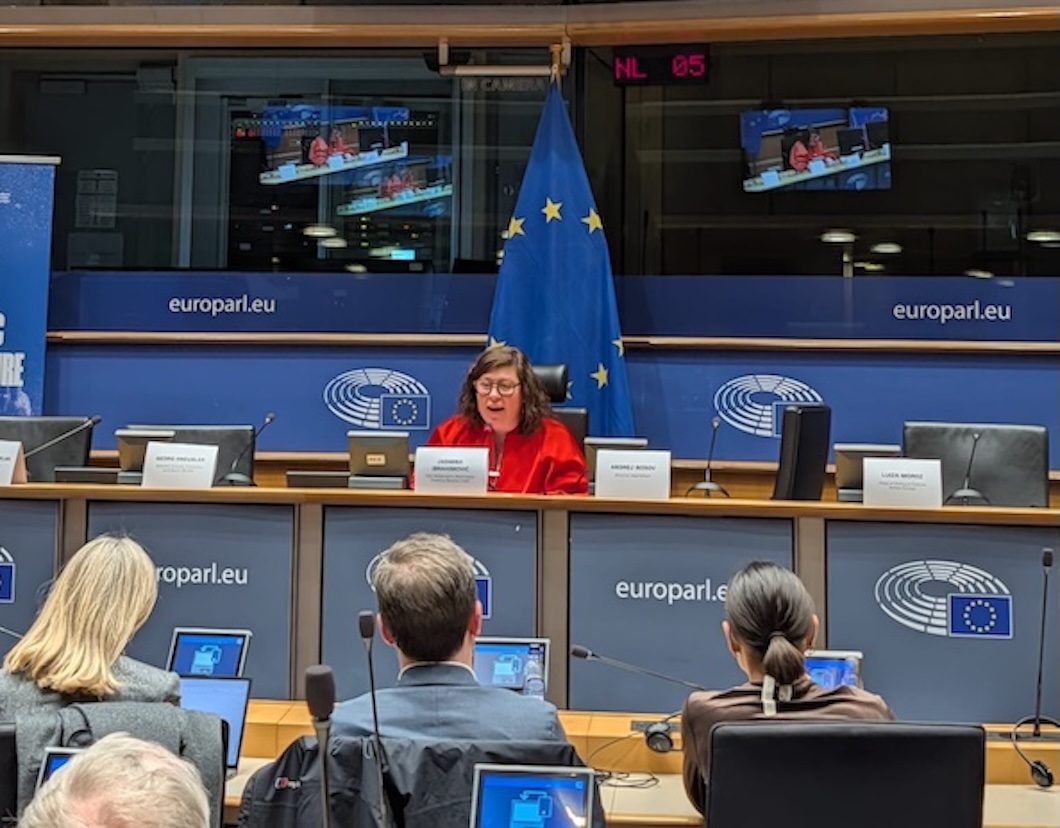
On Tuesday, 3 November, ICAF’s Creative Director Jasmina Ibrahimovic was invited to give a 15-minute keynote at the European Parliament as part of her fellowship with the Alliance for Socially Engaged Arts. The Alliance brought together fellows, foundations, cultural networks and policymakers to discuss the future of socially engaged arts in Europe.
One of the most encouraging moments of the day was hearing colleagues from European institutions speak with conviction about socially engaged arts as essential civic infrastructure. The conversation highlighted the role this work can play in strengthening democracy, participation, wellbeing and social cohesion across Europe.
The Keynote
Jasmina Ibrahimovic, 3 November 2026
I am a theatre-maker.
And that makes this setting slightly uncomfortable for me.
I cannot change the mise-en-scène.
I cannot adjust the light or the sound.
I cannot influence the choreography of this room.
The space we are in has already been fixed.
And it communicates with us before I have said a word.
It tells me that movement is not expected here.
I cannot ask you to come closer.
I cannot come closer to you.
It tells me that this is not a space designed for proximity. That this is a place where we communicate primarily through the mind.
The tables in front of us can become buffer zones for our empathy. We can hide behind them and perhaps also behind our positions, our titles and the roles we have taken on in this room.
A fixed space can create fixed roles.
So all I have with which to reach you is my voice and my story.
I hope that, for the next fifteen minutes, I can invite you into my perspective and my language, so that, if only briefly, we may share the same lived reality.
Because if we can imagine another person’s world, it becomes easier to understand them. And when that understanding is reciprocal, collaboration on equal terms becomes possible.
In 1992, when I was eight years old, my mother and I fled Bosnia, in what was then Yugoslavia. Two years later, when I was ten, we arrived in the Netherlands.
It was a country whose codes I did not understand and whose language I did not speak. Its colours, smells and customs were unfamiliar to me.
After more than thirty years in the Netherlands, I can now say that, at first, I was unable to see fully the country in which I had arrived. I looked at it with my eyes, but not with my heart.
My heart had stayed behind, together with my memories, in the country I had left.
As I gradually began to feel more at home in the Netherlands, the atmosphere towards foreigners was becoming increasingly hostile.
As I grew up, I heard people say that foreigners should go back to their own countries.
When I asked whether I should leave as well then, they would say: “No, I don’t mean you.”
When I asked whom they did mean, they could rarely give me a concrete answer. Everyone they knew personally was somehow excluded from the category.
The person who had to leave was the unknown other: the abstract stranger they had heard about in the news.
After the refugee centre, my first home in the Netherlands was Rozenburg, a small village in the shadow of the Port of Rotterdam, where I also created my very first socially engaged arts project.
Rozenburg had grown from a farming village into a working-class community shaped by generations of port workers arriving from the Netherlands and elsewhere.
My mother and I were often called “import”.
After graduating from theatre school, I returned to Rozenburg to investigate a question: who was a “real” Rozenburger, and when did someone earn the right to call themselves one?
I began the project with genuine curiosity and an artistic mindset.
I created spaces in which I could meet people, and my sincere interest in their stories made them feel heard. After many individual conversations we came together for the first time.
We met in a back room of a community centre: a suspended ceiling, fluorescent lighting and the permanent smell of freshly brewed filter coffee. The youngest was eighteen. The oldest was eighty-one.
Some had never moved house in their lives. Others had migrated thousands of kilometres to get there.
They came somewhat reluctantly, after many persistent invitations – in the first place for me, the slightly strange theatre-maker they did not entirely understand but found sympathetic enough.
In the community centre I tried to change the space as much as I could.
Much to the annoyance of the community-centre manager, I moved the tables aside. I put on some music. I arranged the chairs in a circle.
And I stood at the door to welcome every person individually, with a smile and a hug.
We did warm-up exercises that pleasantly confused them. They could no longer rely on their usual ways of behaving, so they let go and began to laugh.
We shared stories that moved us to tears.
Together, we created a new kind of space.
It became a creative, artistic space for play and for sharing. Slowly, our differences ceased to be barriers. Instead, they sparked curiosity. They became reasons to listen.
Every Monday evening, we shaped that space together.
As a theatre-maker, I created the dramaturgy of each evening: a structure within which personal perspectives could be shared safely. I introduced ways of relating to one another, not by prescribing them, but by embodying them.
At a certain point, everyone began hugging one another at the entrance. Even men in their seventies and eighties who told me they had never hugged their own mothers.
We ate together.
We sang together.
And eventually, we created a site-specific theatre performance, which people from across the village came to see.
Looking back, I realise that while we were making theatre, we were practising a form of everyday democracy.
People did not have to agree or become the same. We learned to stay curious enough to listen to one another and to allow different stories about the same place to exist side by side.
It is harder to hurt someone when you know their story.
The year in which I fled my country, 1992, was also the year in which Rotterdams Wijktheater was founded.
In the years that followed my project in Rozenburg, I came to understand community arts more deeply. I began to recognise the particular artistic value of relational work. And in 2019, I became the director of Rotterdams Wijktheater.
Again and again, our process followed a similar movement.
It began with open encounters between people meeting one another at eye level. From there, we created a shared artistic space in which different lived realities could be expressed and in which we could imagine new ways of living together.
Together with people affected by the Dutch childcare-benefits scandal, for example, we created Verloren Onschuld – Lost Innocence.
In the childcare benefit scandal, thousands of families had been wrongly accused of fraud. Institutional racism meant that people were treated with suspicion because of their ethnic background, dual nationality or the neighbourhood in which they lived. We performed for people who recognised themselves in these stories, but also inside the institutions involved, where the production became part of the onboarding programme for new employees.
Through our International Community Arts Festival, I also discovered a global field of community arts.
At the border between Mexico and the United States, artists installed bright pink seesaws through the bars of the border wall. A structure designed to divide people became an instrument that required cooperation: a seesaw cannot move unless there is someone on both sides.
I encountered the courageous work of Combatants for Peace, a binational Palestinian and Israeli movement resisting occupation and dehumanisation, and of Australia’s Big hART, which carries stories from marginalised communities into places of public influence.
It was through Big hART that I encountered the sentence I have repeated today:
It is harder to hurt someone when you know their story.
But community arts is not simply the collection and presentation of personal testimony.
It is a distinct artistic practice.
The artist does not arrive with a predetermined story and assign people roles within it.
The artist listens, observes and asks questions. The artist creates the conditions in which something not yet known can emerge.
This requires artistic skill: the ability to recognise a meaningful image, gesture or contradiction; to shape many voices without flattening their differences; to work with rhythm, space, silence, tension, humour and imagination; and to transform lived experience into an artistic form that can be shared.
It also requires relational skill.
Reciprocity.
Equality.
Openness.
Curiosity.
Self-reflection.
These are not decorative values added to the work. They drive the artistic process itself.
It allows us to practise the skills on which citizenship depends: listening without immediately defending ourselves, living with disagreement, sharing ownership and imagining a future with people whose experiences differ from our own.
The artist must continually ask:
What is my role in this situation?
Who has the right to tell this story?
Who is being heard?
Who is taking the risk?
And who gets to decide what the final work becomes?
The process changes the artwork and it changes the people involved in it, including the artist.
That is also why its impact and outcomes cannot be determined entirely in advance.
Of course, public funding requires accountability. But when a funding programme demands a fixed social outcome before the first conversation has even taken place, it can undermine the very openness that makes this work possible.
If I enter a community having already decided what its problem is, what story it must tell and how it should change, I am no longer meeting people as equal creative partners.
I am treating them as a target group and the artwork as an intervention.
And I become blind to the stories I was not looking for.
The most important outcome may be one we could not predict: a relationship, a new question, a shift in how people see themselves or one another, or a community gaining the confidence and artistic means to speak in its own voice.
Yet this work is too often created not because funding systems support its reality, but despite the way those systems are designed.
It needs time – because trust does not follow a project calendar.
It needs continuity – because relationships should not disappear when a grant ends.
It needs fair pay – for the artists and for community members whose knowledge, labour and lived experience shape the work.
It needs room for experimentation, uncertainty and even failure.
And it needs funding that values the artistic process itself, rather than reducing art to something to be consumed, something belonging only to our cultural heritage or, worse still, a cheap instrument for solving problems created elsewhere.
Community arts cannot repair every injustice. A performance cannot replace housing, legal protection, social security or accountable government.
But art can create something that many of our institutions struggle to create: a space in which people are not reduced to their vote, their opinion, their function, their file, their label or their political usefulness.
A rehearsal room can be rearranged.
People can move.
Roles can change.
We can try another perspective.
We can make something together that none of us could have made alone.
That brings me back to this room.
I cannot move the tables today.
I cannot change the light.
I cannot alter the choreography.
But perhaps we can make this fixed space slightly less fixed.
Perhaps, through shared stories, the distance between us can become smaller.
And perhaps those of you who shape European cultural policy can help protect the places where that happens; by trusting artists, supporting long-term relationships and leaving room for outcomes that cannot be predicted in advance.
Because a democratic Europe needs places where people can imagine and create together. Places where we can practise living with difference before we are asked to make decisions about one another.
Because it is harder to hurt someone when you know their story.
Thank you.
